Free Clinic Management Software: Really Free?
Looking for free clinic management software? Learn the difference between free, trial and limited versions, the risks, and how to start at no cost.

Free clinic management software usually comes in one of three forms: a trial that lasts a few days, a forever-free version with limited features, or a "free up to a limit" model after which you need a paid plan. Before you start, know which model you're choosing so you're not caught out halfway through.
Three common free models
- Time-limited trial: every feature is open for a few days or a month, then it locks. Good for evaluation, not for long-term use.
- Forever-free but limited: some modules, such as accounting or multi-user access, are removed. If your practice grows, you usually have to migrate your data to another product.
- Free up to a limit: all features are open up to a set number of visits or a set period. This model lets you test the software in real work and then decide.
Risks of completely free software
Software that earns nothing usually has no regular updates or support either. In a medical practice, that means the software can fall behind when regulations or insurance rules change. Even more important is patient data: check where data is stored, whether there are backups and whether you can export your data if you decide to switch. We cover this in patient data security in the practice.
How to get the most out of a free version
- Record real visits from day one, not test entries; only then do you see real speed.
- Involve the receptionist from the start and ask for their feedback.
- Run at least one daily report and one cash reconciliation in the software.
- Test support during this period: ask a question and note the response time.
For a more thorough evaluation, use our 12-point checklist for choosing clinic software.
What does "free" software really cost?
Price is not only the purchase amount. When you choose software, also count these hidden costs:
- Receptionist time: if check-in is slow, every day costs minutes of the receptionist's time and lengthens the queue.
- Migration time: if the free version is limited and you later have to switch, you must set up doctors, services and patients all over again.
- Risk of data loss: software without backups can lose every record with a single disk failure.
- No support: when a problem occurs and nobody answers, the practice stops.
So "free" is only truly free when it doesn't carry these costs.
Checklist before installing a free version
- Are all features open in the free version, or are some locked?
- Is the limit based on time or on the number of visits?
- Is your data kept after the free allowance runs out?
- Are there automatic backups?
- How many computers on the practice network can it run on?
- Does support respond during the free period too?
- Is the price after the free period clear and transparent?
If every answer is clear, you can start with confidence.
Which practices can rely on the free allowance?
Practices that are just starting out or have few visits can work with the free allowance for a long time and only buy a plan when patient volume grows. Busy practices use the free period to test the software properly: a few hundred real visits are enough to judge speed, reports and support.
What to do after the free period
When the free allowance ends you have two options: a visit-based plan for practices with predictable patient numbers, and an unlimited time-based plan for busy practices that don't want to count visits. If your monthly volume is high, a time-based plan is usually better value; if it is low or seasonal, a visit-based plan is.
Three real-world scenarios
A newly opened practice: a doctor who has just opened a practice sees few patients in the first months. The free allowance lets them keep records and accounts organised from day one without adding to start-up costs.
An established practice still on paper: the receptionist has used a paper diary for years and is sceptical about change. The free period is a chance to see, with no financial commitment, how much faster check-in is and how the cash box adds itself up.
A practice unhappy with its current software: before switching, it runs the free version alongside the current product to make sure earlier problems, such as slowness or dependence on the internet, don't exist in the new one.
What to note during the free period
While using the free version, record the following so your buying decision is based on data: average time per check-in, visits per week, problems the receptionist reported, reports the doctor or accountant needed and whether they found them, and support response times. With your weekly visit count you can work out which plan is the better value.
Hamyarteb's free model
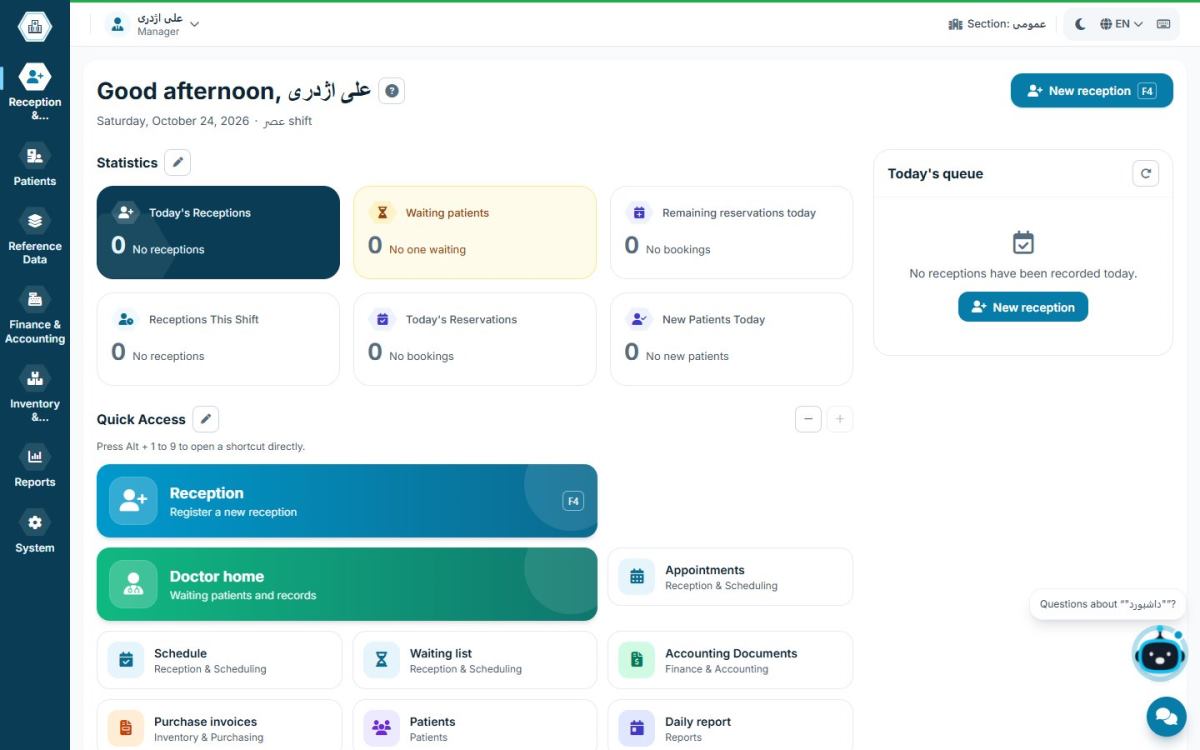
Hamyarteb uses a "free up to a limit" model: after sign-up you get 500 free patient visits with every feature and no time limit. After that you can buy a visit-based plan (1,200, 3,600, 8,000 or 12,000 visits) or an unlimited time-based plan (1, 3, 6 or 12 months). Your data stays on the practice's own server and nothing is lost when you buy a plan.
See also: clinic management software free download.
Frequently asked questions
Is there completely free clinic software?
Yes, but it usually has limited features, support or updates. For long-term use, a free-up-to-a-limit model is safer.
What happens when Hamyarteb's free visits run out?
Your data is kept, and you continue by buying one of the plans.
Does the free version include every feature?
In Hamyarteb, yes; the 500 free visits include every feature.
Does Hamyarteb's free version expire?
No. The 500 free visits have no expiry date.
Is a visit-based or time-based plan better?
A visit-based plan usually suits low-volume or seasonal practices, while an unlimited time-based plan is usually better value for busy practices.