Visit history
Every visit, service and treating doctor on a single timeline.
In Hamyarteb every patient has an electronic record: visit history, diagnoses, medications, lab requests, medical images and the doctor's notes. The doctor opens the record from their own desk and sees the full history without searching a filing cabinet.

Photo by Vitaly Gariev on Unsplash
Paper files take up space, get lost, are hard to read and are only available in one room. When a patient returns months later, finding their previous prescription or test result costs the doctor and receptionist time, and sometimes it can't be found at all.
Electronic patient records put all of this side by side on one screen. The doctor reviews the history in seconds, records the new diagnosis and medications, and everything is ready for the next visit. With access levels, only authorised people can see the record.
Every visit, service and treating doctor on a single timeline.
Pick diagnoses from a list and record them in the file to follow conditions over time.
Record prescribed drugs from the medication list and see the patient's previous prescriptions.
Record the tests requested for the patient in the same record.
A gallery of the patient's images and documents, with annotation on images.
Mark the affected area on a body diagram and save it to the record.
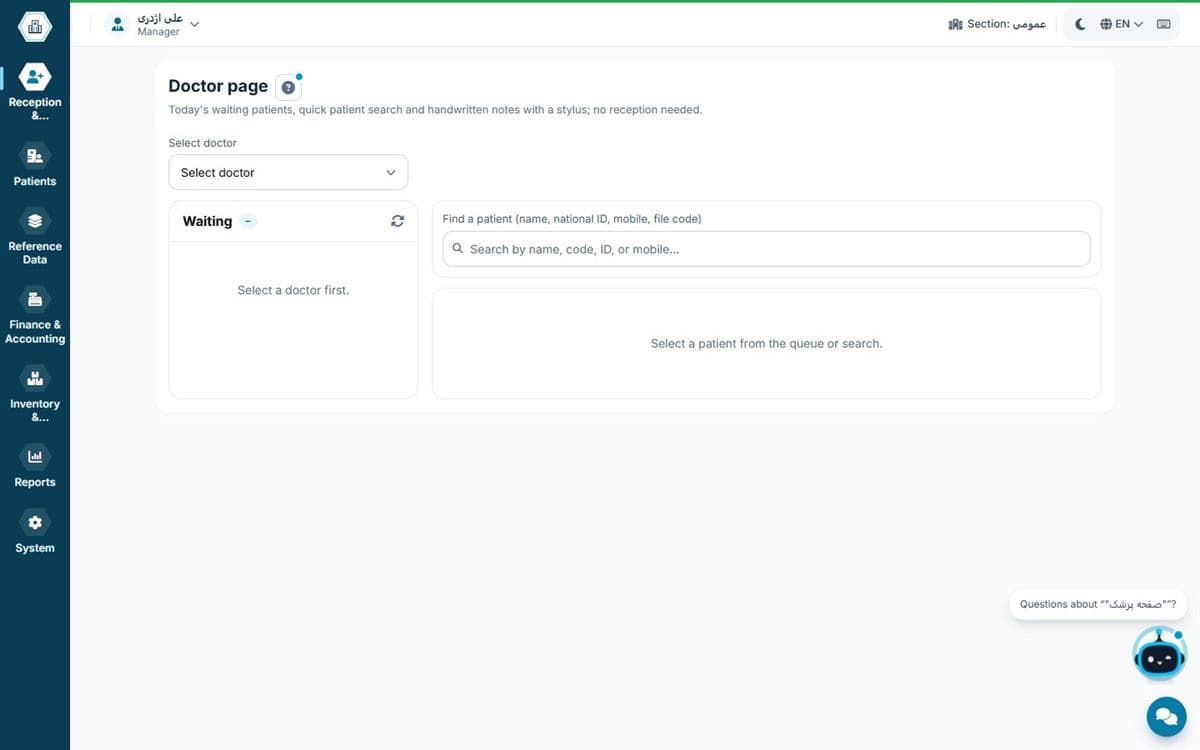
The waiting list and the current patient's record side by side on the doctor's computer.
Medical records are open only to the doctor and authorised users, and changes are logged.
In a practice, the record is shared by doctor and receptionist, and the receptionist sees only what they need. In a clinic, each doctor can also see the patient's history in other departments. In dentistry, the record is completed by the treatment plan and tooth chart.
Compare editionsFor new or low-volume practices
For GP and specialist practices
For busy practices and small clinics
For multi-doctor clinics and polyclinics
Rial payments via bank gateway · USDT outside Iran
No; active patients are registered at their next visit and records fill in over time.
On the practice's own server, not on the internet, with automatic backups.
It depends on access levels; usually receptionists see only identity and billing information.
Yes; images and documents are kept in the patient's record gallery.
Yes, for authorised users; every computer connects to one database on the practice network.